Guide
Urban renewal guide
If your building was found to be a risky building, or renewal is being discussed, the process can look long and confusing. This guide explains the key steps of Law No. 6306 in plain language and shows where your belongings can wait in the meantime.
The law text was checked against its current version on mevzuat.gov.tr on 1 November 2026.
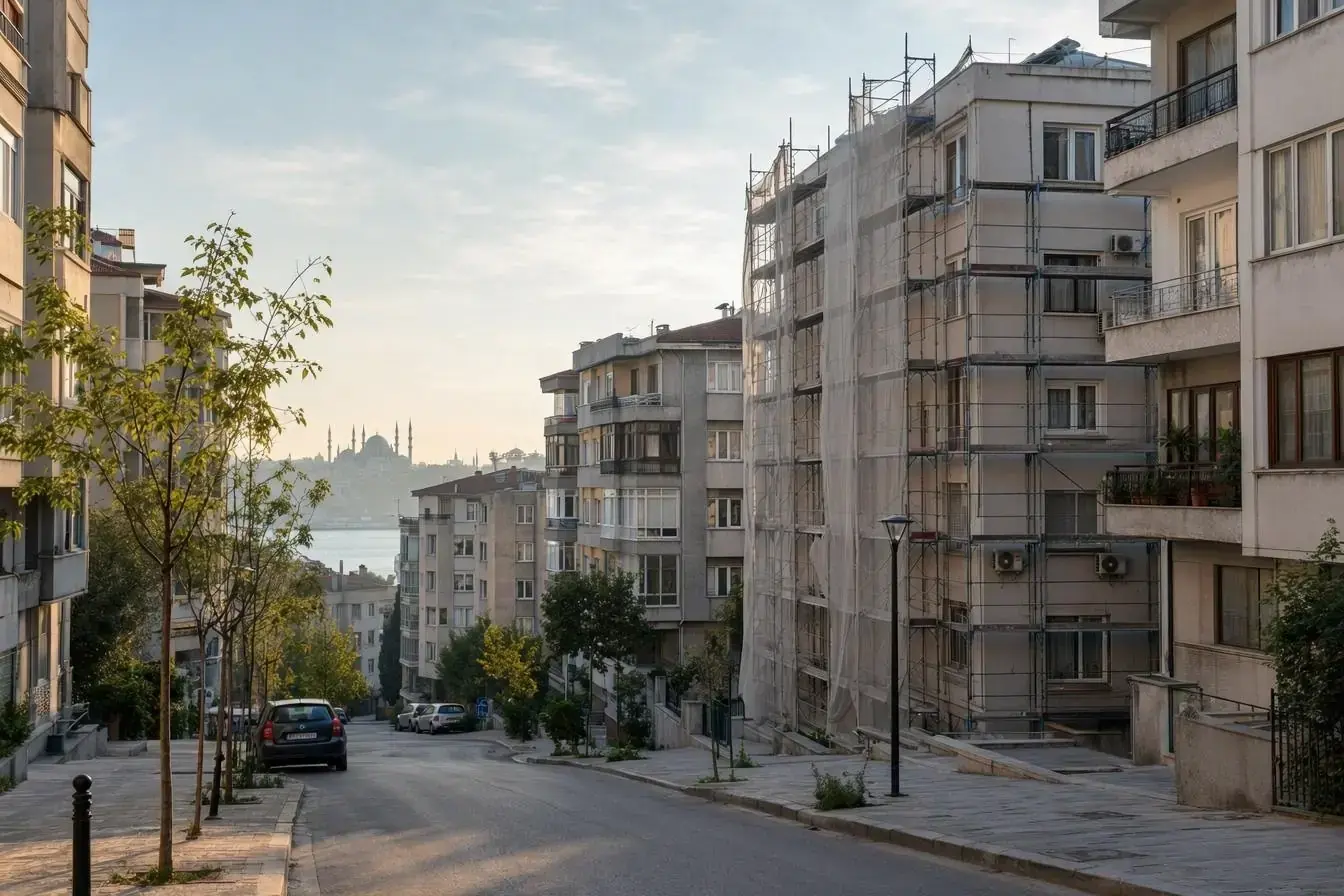
What does urban renewal law regulate?
Law No. 6306 on the Transformation of Areas Under Disaster Risk sets out how improvement, clearance and renewal work is carried out in risk areas and on land with risky buildings, so that living environments are healthy, safe and meet technical standards (art. 1).
Under the law a risky building is one that has completed its economic life or, on scientific and technical data, is found to risk collapse or heavy damage (art. 2). The Urban Transformation Directorate (Kentsel Dönüşüm Başkanlığı) and municipalities (the "İdare") carry out the work.
The process at a glance
Each step has its own chapter with law articles and official sources.
- 1AssessmentRisky-building assessment, the 15-day objection period and the note in the title deed.
- 2DecisionThe decision of owners by a simple majority of shares.
- 3EvacuationAt most 90 days to demolish; moving belongings out.
- 4Building and handoverThe contractor agreement, delays, and your rights at handover of the new flat.
A roadmap for your situation
Choose your stage, your role and your home size to get your to-do list, papers and storage plan on one page. Your choices are kept in the # part of the page address.
Chapters of the guide
Read them in order or jump to the one you need.
- Chapter 1 of 11What is a risky building and how is it assessed?What a risky building is under Law 6306, who orders the assessment, how long you have to object and how the title deed note works.Read chapter
- Chapter 2 of 11Urban renewal in Türkiye, step by stepThe eight stages of urban renewal under Law 6306, from the first assessment to receiving the new flat, and what is expected of residents at each step.Read chapter
- Chapter 3 of 11Agreement between owners: how decisions are made and which deadlines applyHow owners agree in urban renewal: the simple majority of shares, the 15 and 30 day periods, and what to check in the contractor contract.Read chapter
- Chapter 4 of 11Rent aid and construction aid: what exists and where to find out moreRent aid, construction aid, the e-Devlet application, İstanbul Yenileniyor and fee exemptions in urban renewal, and where to check current amounts.Read chapter
- Chapter 5 of 11Credits, interest support and exemptions: what the Law providesCredits, housing certificate, interest support, strengthening credit and fee exemptions in Law No. 6306, and how to find out which ones are open to you.Read chapter
- Chapter 6 of 11Planning temporary housing and rent in urban renewalHow to plan a temporary home during urban renewal: allowing a margin on the delivery date, home size, what goes into storage, and what to check in a lease.Read chapter
- Chapter 7 of 11Evacuation and demolition: deadlines, notices and a move-out timelineHow evacuation and demolition work for a risky building under Law 6306: the 90-day period, notices, service cut-offs and a practical move-out timeline.Read chapter
- Chapter 8 of 11Moving and storage costs: who pays and how to budgetWho pays for moving and storage during urban renewal? What the Law says, how to budget two moves, ways to cut costs and questions to ask providers.Read chapter
- Chapter 9 of 11Storing belongings during urban renewal: volume, time and preparationWhere do belongings wait during urban renewal? Estimating volume and time, preparing items, choosing a provider and how a room works at Atasoy Depo.Read chapter
- Chapter 10 of 11Tenant and owner rights in urban renewalOwners, tenants and limited real right holders are treated differently under Law 6306: the one-year rule, delivery period and 30-day court deadline.Read chapter
- Chapter 11 of 11Documents and checklist for urban renewalTitle deed, assessment report, notices, contracts and a home inventory: the documents to gather and keep for years during an urban renewal under Law 6306.Read chapter
Rent, moving, storage and other supports
Read which supports the law text says may be granted, which it does not mention, and how to plan the costs that fall to you.
- Rent aid and construction aid: what exists and where to find out moreRent aid, construction aid, the e-Devlet application and İstanbul Yenileniyor.
- Credits, interest support and exemptions: what the Law providesCredit, the housing certificate, interest support and fee exemptions; how to find out which are open to you.
- Planning temporary housing and rent in urban renewalThe temporary home, rent aid and contractor-paid rent; what to check in a temporary lease.
- Moving and storage costs: who pays and how to budgetWho bears moving and storage costs; how to budget two moves and storage.
Where do belongings wait during renewal?
The temporary home is often smaller than the old one, and construction runs until the delivery date in the contract. Atasoy Depo keeps belongings in locked rooms; at the free survey we work out the volume together.
Read the storage chapterOpen the storage planner0532 238 10 41
Ask the guide
The roadmap page has an AI-assisted assistant that gives short answers based on the content of this guide.
Frequently asked questions
Who orders the risky-building assessment?
Under the law the assessment is first commissioned by the owners or their legal representatives, at their own cost, from institutions licensed by the Directorate. The Directorate or the municipality may also do it ex officio or ask owners to do it within a set time (art. 3).
Do all owners have to agree?
No. Decisions such as rebuilding are taken by a simple majority of shares; a 2023 amendment replaced the earlier "at least two thirds" with a simple majority. Owners who did not agree are notified, and if the offer is not accepted their land shares are sold under the procedure in the law (art. 6).
How long do owners have to demolish the building?
Owners are given a period of at most ninety days. If the building is not demolished in that time the administration demolishes it and the costs are collected from owners in proportion to their shares (art. 5).
How long does urban renewal take?
The law sets no construction period; it depends on the contract with the contractor, the permit and the project. When planning for belongings it makes sense to add a safety margin to the delivery date in the contract.
Does the state pay for storing belongings?
The law text has no provision on the cost of storing belongings. For buildings evacuated by agreement, temporary housing or rent aid and construction aid may be given; ask the Directorate and the municipality what is on offer (art. 5).
I am a tenant; can I get support too?
The law says tenants of buildings evacuated by agreement may also be given temporary housing or rent aid (art. 5). Tenants who have lived in the building for at least a year may be offered housing, credit or a housing certificate (art. 6). These are things that may be granted, not automatic rights.
This guide is general information, not legal advice. For your own case, ask the Urban Transformation Directorate, your municipality or a lawyer.